


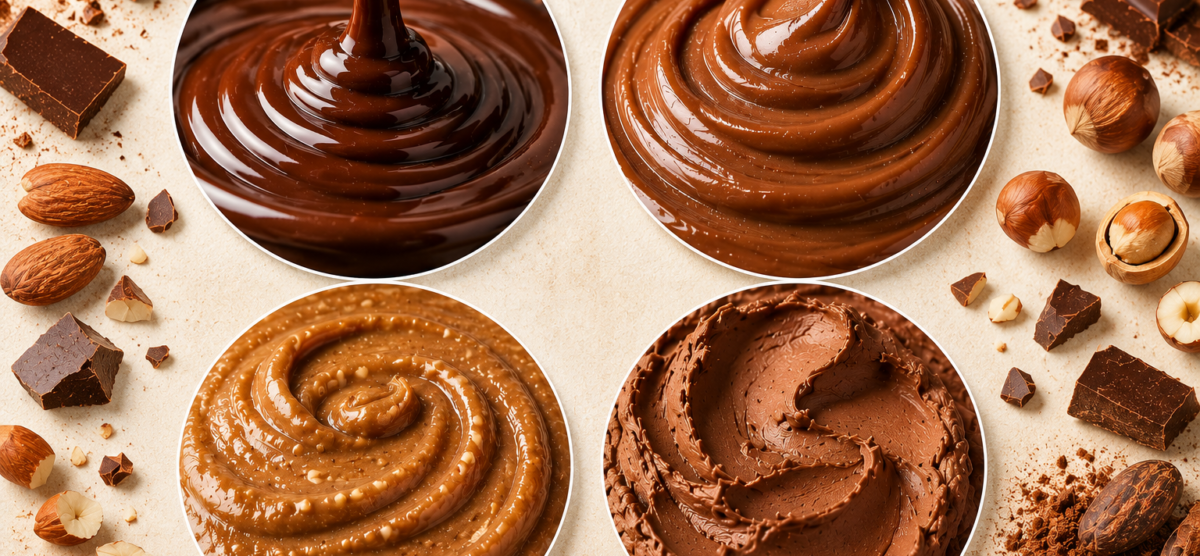
GLAZE AND FILLING PREPARATION SYSTEMS BASED ON A BALL MILL
Chocolate glazes and confectionery fillings are widely used in the production of candies, bars, biscuits, wafer products, desserts, and other confectionery products. Their quality determines the taste characteristics, texture, appearance, and stability of finished products during storage.
The growing requirements for confectionery product quality encourage manufacturers to implement modern technologies for mixing, grinding, and automation of production processes. One of the most effective solutions for the production of glazes and fillings is equipment based on a ball mill, which ensures high product uniformity and process stability.
L-TRANS SERVICE develops and manufactures equipment for the production of chocolate glazes and confectionery fillings, taking into account recipe specifications, required production capacity, and the level of automation of the enterprise.
WHAT PRODUCTS ARE THESE SYSTEMS DESIGNED FOR?
The equipment can be used for the production of:
- chocolate glaze;
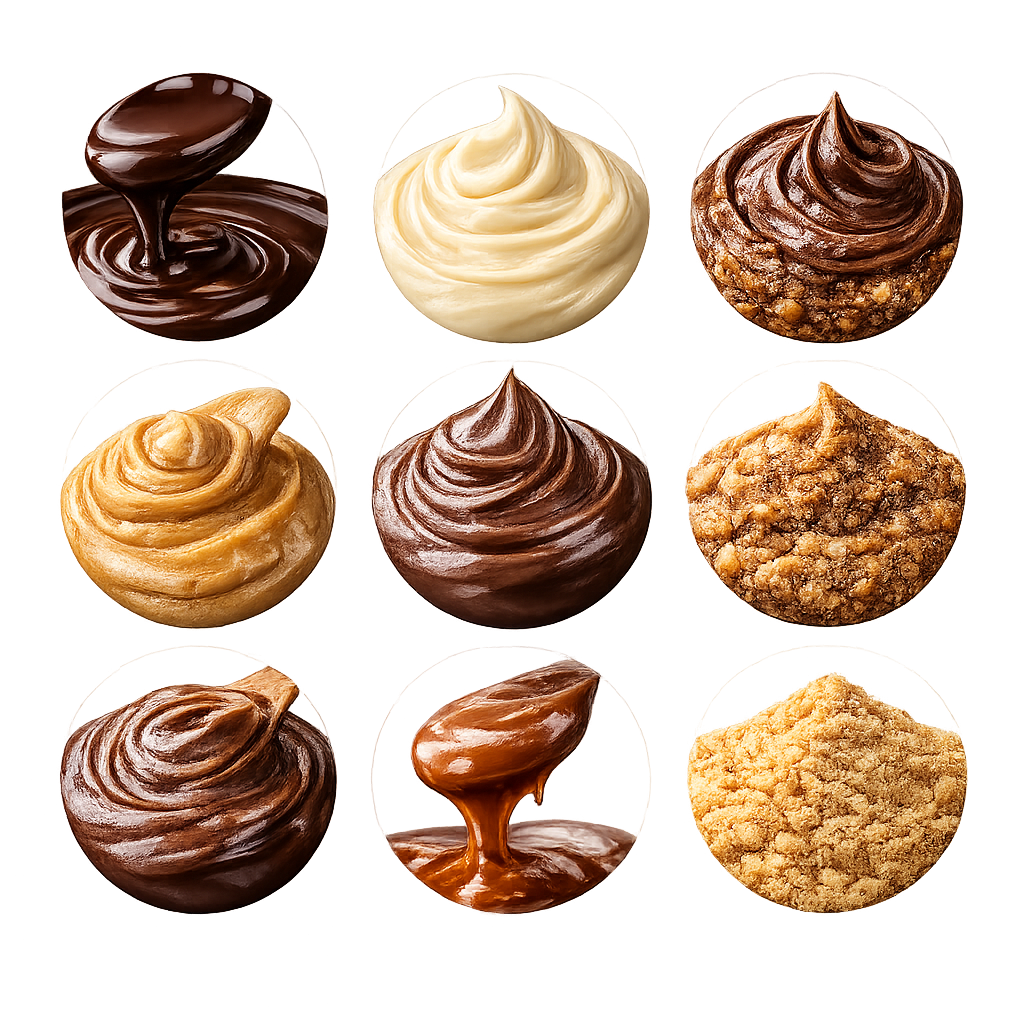
- confectionery glaze;
- fat-based fillings;
- chocolate fillings;
- praline masses;
- cream fillings;
- nut pastes;
- fillings for bars;
- fillings for wafer products;
- fillings for candies and desserts;
- other confectionery masses based on fats.
Depending on the recipe, the product composition may include sugar, cocoa powder, cocoa liquor, vegetable fats, dairy components, nut pastes, flavourings, and other ingredients.
FEATURES OF GLAZE AND FILLING PRODUCTION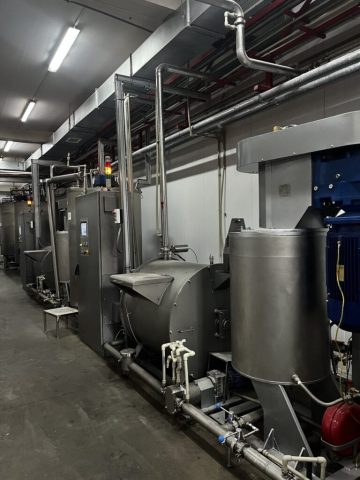
The production of chocolate glaze and confectionery fillings requires precise compliance with the recipe, stable temperature conditions, and high-quality raw material preparation. Even minor deviations can affect the product consistency, flowability, structure, and taste characteristics.
One of the most important parameters is the degree of grinding of dry components. Excessively large particles of sugar or cocoa powder can create undesirable graininess and reduce the quality of the finished product. That is why modern technologies involve the use of ball mills, which provide fine grinding and uniform distribution of components throughout the mass.
WHAT TYPES OF FILLINGS CAN BE PRODUCED?
Systems based on a ball mill allow the production of a wide range of confectionery fillings for various types of products.
The most common include:
- fat-based fillings for wafer products;
- chocolate fillings for bars and candies;
- praline masses;
- nut pastes;
- cream fillings;
- combined confectionery masses;
- fillings for multilayer products.
The parameters of the technological process are selected individually depending on the recipe, required consistency, and characteristics of the finished product.
PRINCIPLE OF OPERATION OF A BALL MILL
The ball mill is the key element of the system for the production of glazes and fillings.
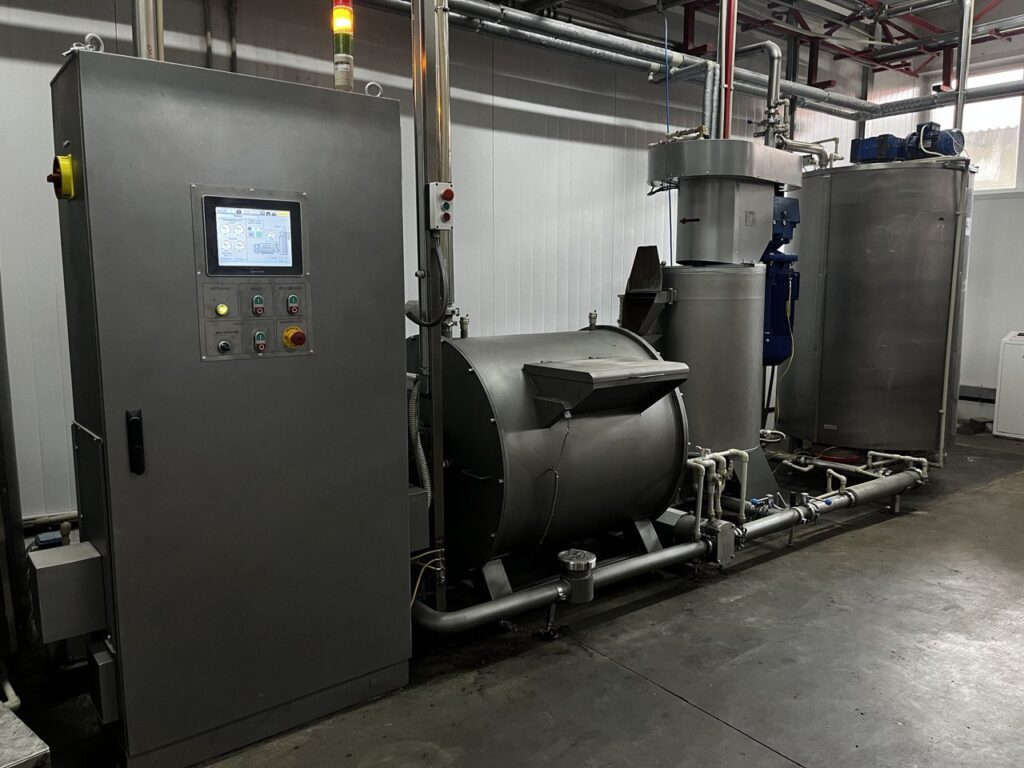
Before entering the mill, the components undergo a pre-mixing stage in a premixer. After that, the mixture enters the working chamber, where intensive grinding and homogenization of the product take place using grinding media.
During processing, the required degree of particle dispersion is achieved, as well as uniform distribution of the fat phase throughout the entire product volume. As a result, a homogeneous mass with a stable structure, required viscosity, and high taste characteristics is formed.

ADVANTAGES OF USING A BALL MILL
Ball mills are widely used in the production of glazes and fillings due to a number of advantages:
- high quality of component grinding;
- homogeneous structure of the finished product;
- stability of the technological process;
- ability to work with various recipes;
- high production capacity;
- compact equipment design;
- possibility of integration into automated production systems;
- optimization of production costs.
That is why ball mills are one of the most popular solutions for the production of confectionery glazes and fillings at modern enterprises.
SYSTEM CONFIGURATION
The equipment configuration is selected individually according to the product recipe and required production capacity.
The system may include:
- sugar and other bulk ingredient feeding systems;
- automatic dosing systems;
- a premixer for preliminary component mixing;
- a ball mill;
- fat melting chambers;
- storage tanks for finished products;
- product transfer pumps;
- piping systems;
- an automated control system.
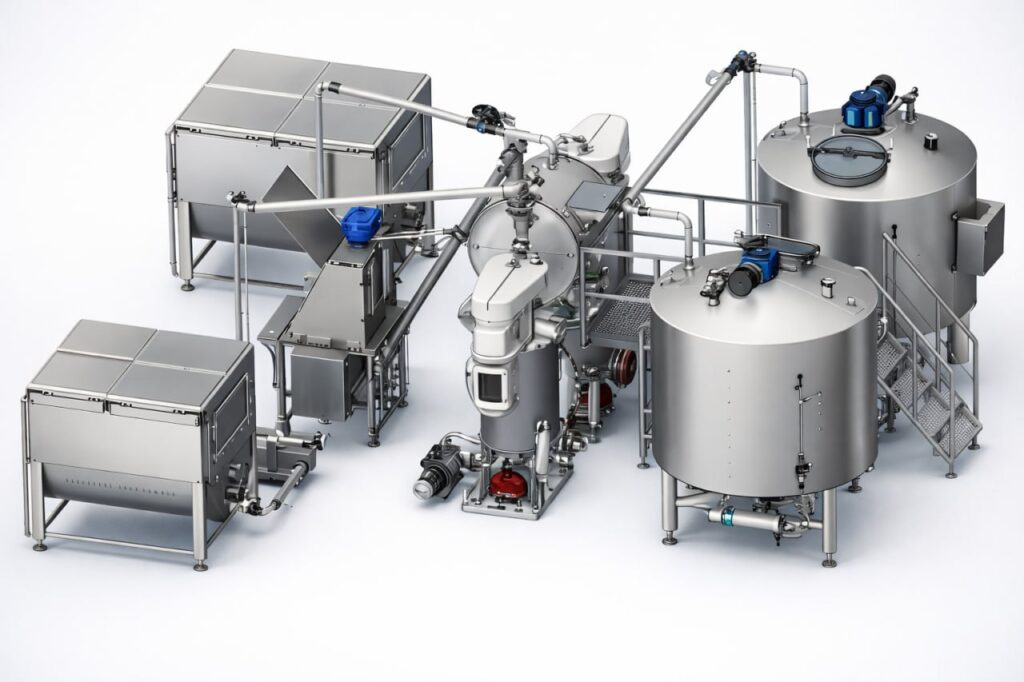
Depending on production requirements, solutions can be implemented either as a separate technological unit or as part of a fully automated production complex.
AUTOMATIC COMPONENT DOSING
Modern production systems allow automation of the feeding and dosing of the main recipe ingredients:
- sugar;
- cocoa powder;
- cocoa liquor;
- vegetable fats;
- dairy components;
- nut pastes;
- lecithin;
- flavourings;
- colourants;
- other recipe components.
Automation ensures high dosing accuracy, recipe repeatability, and stable quality of the finished product from batch to batch.
AUTOMATION OF THE PRODUCTION PROCESS
Control systems based on industrial controllers and touch panels provide monitoring of all major production parameters:
- component dosing;
- temperature conditions;
- operation of pumps and mixers;
- technological process parameters;
- product recipes;
- production statistics and data archiving.
Automation improves production efficiency, reduces raw material losses, and ensures stable product quality.
ADVANTAGES OF L-TRANS SERVICE SOLUTIONS
L-TRANS SERVICE equipment provides:
- high product grinding quality;
- homogeneous structure of glazes and fillings;
- stability of finished product characteristics;
- automation of production processes;
- ability to work with different recipes;
- production scaling according to enterprise requirements;
- integration into existing production lines;
- reduction of the human factor impact;
- an individual approach to each project.
CUSTOM SOLUTIONS FOR GLAZE AND FILLING PRODUCTION
L-TRANS SERVICE specialists develop systems for the production of chocolate glazes and confectionery fillings, taking into account product characteristics, required production capacity, and the level of enterprise automation.
Depending on production requirements, solutions may include an individual ball mill, a system with a premixer, or a fully automated system with automatic ingredient dosing and centralized control of the technological process.
This approach makes it possible to create efficient solutions for the production of a wide range of glazes and fillings in accordance with the requirements of modern confectionery production.